Piano, drums, singing or music production: where should your child start?
Start with the part of music your child wants to try, then offer a small activity in that area. There is no single best first instrument or route for every child. A choice can change after a few experiences, and interest in one area does not rule out the others.
This guide helps you explore interests. It does not match instruments to personality types, set a universal starting age or recommend equipment to buy.
Listen to the question behind the interest
“I want to make music” can mean “I want to play that tune,” “I want to make a beat” or “I have words for a song.” Ask your child to show or describe the bit they like. You do not need to turn that answer into a long-term commitment.
Try one of the routes below. These activities suggest what to explore next; they do not assess talent or predict progress.
Keyboard and piano: explore notes and patterns
If your child wants to find tunes or try several notes together, explore a short pattern. Hum a phrase, draw whether its notes go up or down, then repeat it. If a suitable keyboard is already available, ask a teacher to help with physical setup and technique.
A browser note pattern can demonstrate pitch and repetition. It cannot assess hand position, posture or how a child uses a physical piano.
Drums and rhythm: explore a pulse and a pattern
If your child taps along to songs, take turns copying a clap pattern over a steady pulse. You can say “tap” instead of clapping or use another comfortable response. Try one pattern, then leave one sound out and listen again.
Hearhood’s beginner beat guide explains how a screen pattern is built. That is a different task from learning stick grip, pedal use or physical drum technique.
Singing: explore a phrase comfortably
If your child enjoys songs and voices, let them choose a short phrase to hum, speak or sing comfortably. Compare two endings without asking for a louder or higher performance.
Learning vocal technique calls for appropriate individual guidance. A recording or app cannot tell you that a technique is right for a particular child.
Songwriting: explore words, stories and a tune
If your child invents characters or lines, ask for a sentence about an imaginary situation. Repeat it with a different rhythm, then try another ending. It does not have to rhyme, and it does not need personal details.
For more structure, the lyric-writing guide explains how a first verse and chorus can develop. An original line on paper is a useful place to begin.
Production: explore how sounds fit together
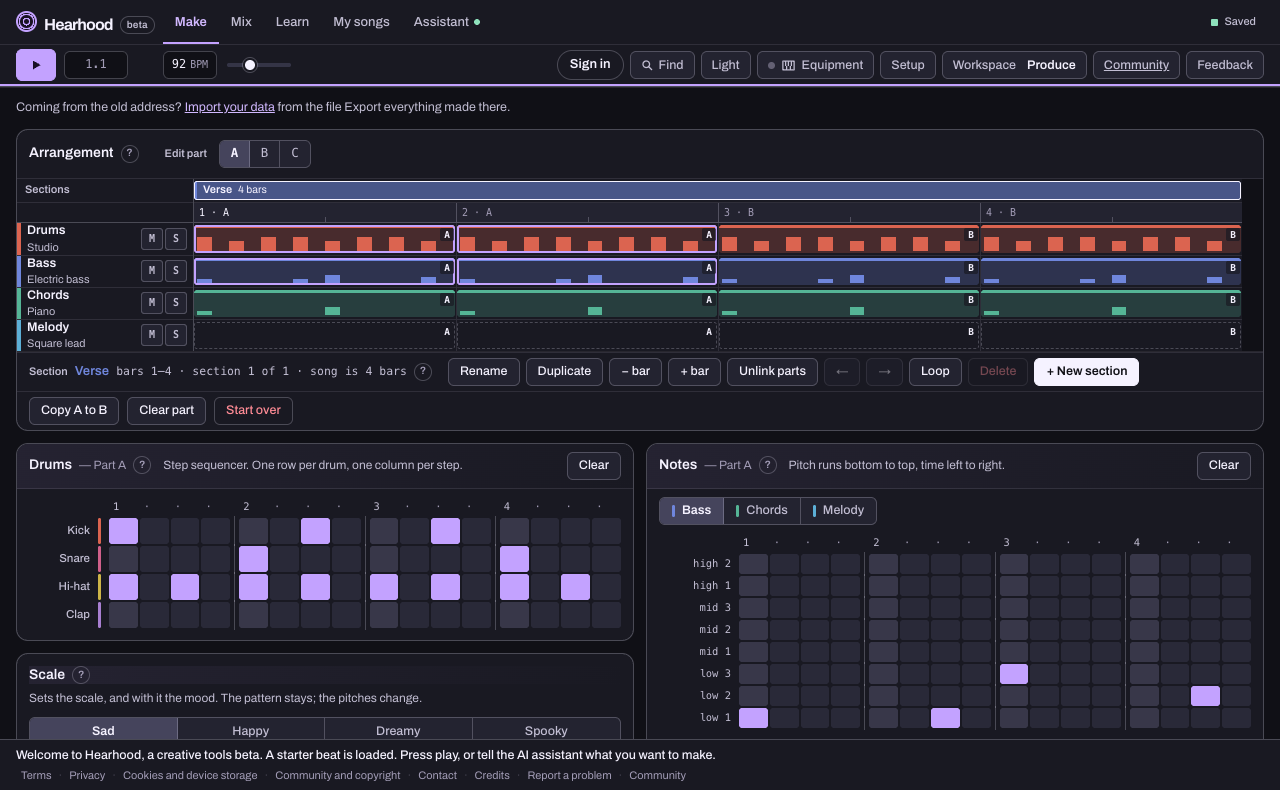
This reference capture illustrates parts arranged together in Hearhood. It is an example of a screen-based music-making tool, not a test for choosing an instrument or permission for a young child to use the service.
Music production includes choosing and arranging sounds, recording where needed and deciding how parts balance. A first exercise could compare a tune with a rhythm underneath and the same tune without it. Ask which part changes the feeling.
Hearhood’s first mixing guide introduces listening decisions about levels and space. Production is a musical route in its own right; a screen exercise still does not teach physical instrument technique.
Guitar or bass: explore the role before the technique
Listen to a short passage together and notice a repeated low part or a chord pattern. Ask whether your child is drawn to that role. You can explore repetition and contrast without owning the instrument.
If the interest continues, seek guidance on an appropriate physical instrument and setup. This page cannot assess instrument fit, finger technique or playing comfort remotely.
Try, notice and choose the next step
After an activity, ask: “Would you like to do that again, change it or try something else?” Keep the answer small. A next step might be repeating the same game, trying a lesson or asking a teacher about an instrument.
Listening, composing and performing are connected in England’s music programmes of study. The routes here borrow that broad idea of exploring music in several ways; they are not an accredited curriculum or a research-based instrument-selection test.
Using Hearhood with a young learner
The music activities by age cover different teaching levels. Check the family access guide and the service’s current rules before an app activity. Under-13 accounts are unavailable; an age label on a course does not change that. The listening and invented-word activities described here can be done offline without a child account.
Common questions
Must my child learn piano before making beats? The clap-and-pattern exercise here needs no piano knowledge. Broader musical learning can develop alongside an interest in production.
Can an app replace an instrument teacher? Screen activities can introduce musical ideas. They do not check the physical technique needed to play an instrument.
Should we choose by age alone? Use teaching age bands as starting points. Consider the learner’s interest, access needs and the support available for the particular activity.
About this guide
Prepared for Hearhood by Scopra with AI assistance. The examples are exploratory activities, not an assessment of a child’s abilities or advice from a named instrument teacher. See about Hearhood.
Explore one instrument interest more closely
These parent guides offer a small offline task and questions to take to an introductory lesson. They do not teach physical playing technique or require an instrument purchase.
- Piano and keyboard: explore pitch order and a short tune shape.
- Guitar: compare accompaniment and tune-making roles.
- Bass: notice low notes, timing and space.
- Drums: keep a pulse while changing a pattern.
For a sequence of activities, choose a learning route.