Write a first verse and chorus
To write song lyrics, choose a clear subject, describe a moment in concrete language, and read the lines aloud over a steady pulse. Let the verse develop the situation and the chorus return to its main feeling. Rhyme can help, but it should not force you to say something you do not mean.
1. Choose a moment you can picture
“I miss someone” is a subject. A spare cup left beside the sink is an image. Write three details from a scene: something you can see, something you hear and something someone does. You can invent the scene; you do not have to reveal a private experience.
For this exercise, imagine someone about to move out of a flat. The details are a half-packed box, two spare keys and a light left on in the hall.
2. Make a small verse
A verse gives the listener somewhere to stand. Try four short lines that show the situation rather than explain the whole story. This is an original teaching example:
- The box is waiting by the door
- Two keys are lying on the floor
- You leave the hallway light on low
- As if there's nowhere else to go
“Door” and “floor” rhyme, but the scene matters more than the rhyme. Replace a line if it does not sound like something you would say.
3. Find the phrase to return to
A chorus can repeat a useful phrase, state the main feeling or change how we understand the verse. It does not have to summarise every detail. One possible chorus for this exercise is:
- Leave a light on, leave a light on
- I'm not ready for the dark
- Leave a light on, leave a light on
- Till I know where we can start
The repeated phrase gives the chorus a centre. Try saying it once with more words and once with fewer. Keep the version that gives you room to breathe and sounds like the song you want to make.
Try three versions of the same chorus
Keep the scene and backing unchanged so you can hear what the words change. Here are three original teaching drafts:
- A, explaining the feeling: “I keep wondering if you might come home / I do not want to be alone.” This says what the singer feels, but both lines explain it in broad terms.
- B, finding the hook: “Leave a light on, leave a light on / I am waiting by the door.” Repetition gives you a phrase to recognise. The last line returns to the verse's scene.
- C, changing what the hook means: “Leave a light on, leave a light on / I need somewhere to begin.” The light can now suggest a future as well as waiting for someone.
Speak each version over the same four-bar backing. Notice where you have to rush, which words you remember after a pause and whether the chorus changes the feeling of the verse. C is not an answer key. If waiting is the point of your song, B may fit better.
In the Lyrics tab, keep the alternatives as text before replacing a draft. Typed words are not sung automatically. Record yourself separately if you want to compare performances. The lyrics and melody exercise helps when a line looks good but feels crowded when sung.
4. Speak the words over a beat
Tap a steady pulse and speak each line. Mark a word you rush, a syllable that feels awkward and a pause that sounds useful. Try cutting a word before changing the tempo. Different styles place syllables differently; every line does not need the same length.
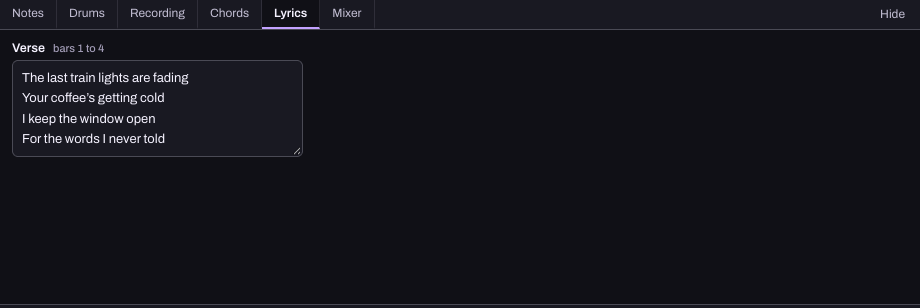
In Hearhood, open Songwriter and use the Lyrics tab to keep the words with the song. The start-a-song walkthrough shows how to add a backing beat. Text in the lyric box does not become a sung vocal.
5. Revise one thing at a time
- Replace a vague word with a detail you can picture.
- Remove a word that makes a line difficult to speak.
- Keep a surprising phrase if it fits your meaning.
- Check that the chorus adds something to the verse.
Save an editable copy using the save and export guide. Your useful result today is a verse, a possible chorus and a note about what to change. You can write the rest after you hear how this part feels.