What do I write in the second verse?
A useful second verse gives the listener something they have not heard yet: a new detail, a consequence, a different perspective or a small decision. Start with what changed after the first verse. Keep the chorus as a reference, and try a few lines before rewriting the whole song.
You have a verse you like and a chorus that keeps coming back. Every second-verse attempt seems to say the same thing with different rhymes. That is a good moment to change what happens, rather than search for another word for the same feeling.
1. Give each part a simple job
Write one sentence for the first verse and one for the next. For example: “In verse one, someone is still waiting. In verse two, they make one small change.” The story does not need a dramatic ending. A different action can be enough.
Here is an original two-line sketch for each verse:
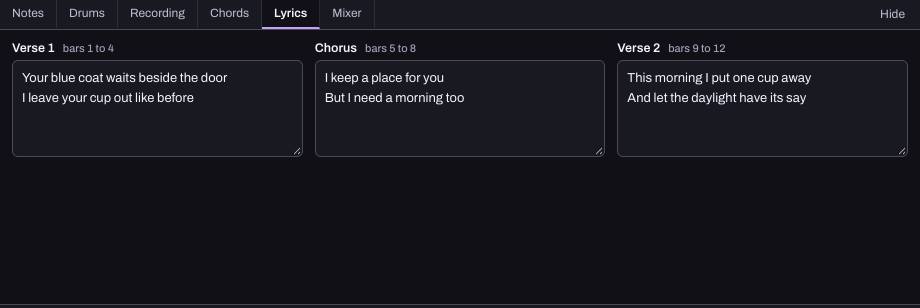
- Verse one: Your blue coat waits beside the door / I leave your cup out like before
- Verse two: This morning I put one cup away / And let the daylight have its say
The second image develops the first. It does not explain that everything is suddenly fine. You can keep that uncertainty if it suits the song.
2. Put the sections beside each other in Hearhood
Open Workspace, choose Songwriter, then choose the Lyrics tab under the timeline. You can begin with a single box and label your drafts inside it. If you want separate boxes, use + Section above the timeline. Each marked section gets its own lyric box.
In the new-song exercise shown here, four presses created Intro, Verse, Chorus and Verse 2, each four bars long. An existing song may already have sections, so check its timeline before adding more. These are starting labels and lengths, not a required song structure.
3. Choose one way to move the song forward
Try one of these questions, then write two lines in plain language:
- What happens next? Someone leaves, calls, returns or chooses not to.
- What is the consequence? Show how the first verse's situation affects an ordinary moment.
- What did we miss? Reveal a detail that changes how the listener understands the scene.
- Who sees it differently? Describe the same event from another person's viewpoint.
You do not need all four. Pick the one that makes you want to hear the chorus again. If a rhyme forces a confusing line, keep the clear version and return to the rhyme later.
4. Return to the chorus and listen
Sing the new lines, then the chorus. Does the repeated chorus now carry a slightly different meaning? In the example, keeping a place for someone sounds different after the cup has been put away.
Use your existing tune if it still works. A second verse can share the first verse's melody, or change it when that serves the song. If the new words feel crowded, work through fitting lyrics to a melody.
Does verse two have to be longer or more intense?
No. Length and intensity are choices. For this exercise, keep it short enough to compare with verse one. Adding instruments, more words and a bigger vocal all at once can hide whether the new idea itself is useful.
The separate lyric boxes organise words. They do not create a sung performance. To develop the backing beyond a repeated loop, use turn a loop into a song.
What if I still have nothing?
Write a deliberately rough version that begins “The next morning...” or “What you did not see was...” You can remove those words later. Their job is to get you into a new moment. Stop after two or four lines and sing them before polishing.
Keep both attempts until you have compared them. Use Export and Song file for an editable copy. The no-account creative tools are free during the current beta; saving in the browser is not a cloud backup.