A four-week music plan for ages 14-17
Use one small focus each week: rhythm, melody, words, then a short idea that joins your favourites. This is a flexible parent plan, not four deadlines or a test. Repeat a week, change the order or stop when that better fits the learner. The age band is a suggested starting level.
The child activities are offline and use paper, a pencil and optional soft sounds or comfortable humming. No instrument, app, child account, recording or public sharing is required. Older learners can decide whether they want a partner or just help setting up. Pointing, drawing and describing support planning and discussion; they do not claim to reproduce every listening or performing task.
Before the first week
Open the ages 14-17 activity pack. Choose one activity for the first session and leave the rest for later. Ask what the learner wants to try. A few minutes is enough to begin; there is no required lesson length or weekly completion score.
Week 1: shape a handover
Plan four bars of four counts using the pack grid. Compare a busy and a quiet last bar while keeping the first three bars fixed.
Keep: Keep both versions of bar four.
Ask together: Which ending best prepares the change you intended?
Week 2: give a motif a purpose
Choose a calm or restless brief and compare the same motif with two endings. Keep the rhythm fixed for this first comparison.
Keep: Write the brief and one specific reason for choosing A or B.
Ask together: What in the contour supports your choice?
Week 3: edit a hook
Use an invented scene such as a station after the final train. Keep draft A, make one concrete-image edit for B and speak both at the same pace.
Keep: Keep the before-and-after lines.
Ask together: Does the repeat carry the main idea, or only fill space?
Week 4: present a private miniature
Choose a brief such as a late-night walk turning into morning. Plan two short sections and one deliberate contrast in rhythm, contour or lyric. Share your explanation only with a chosen partner if you want; an offline sketch is enough.
Keep: Keep the brief, two-section plan and one revision note.
Ask together: Can you explain one choice and one thing you would investigate next?
Decide what happens after week four
Ask which part the learner would like to return to: sounds and timing, tunes, words, or putting ideas together. Interest can change. Repeating a favourite task is a useful next step; finishing this plan does not prove readiness for a graded exam or a particular instrument.
For a possible instrument route, use choosing a music-learning path. For more flexible home sessions, return to the home music plan.
Optional preparation for the adult
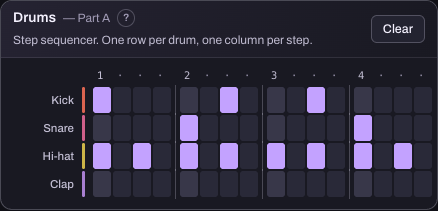
This reused app capture shows a rhythm grid for separate adult preparation. It is not the paper activity, evidence of a child session or a required step. The adult can also find Prepare a pulse-and-pattern activity under Short courses in the app. That practice course does not create a child account or assess the learner.
Under-13 accounts are unavailable. Before any separate app activity, check the current family access guide and service rules. A lesson age label does not grant access.
About this plan
Prepared for Hearhood by Scopra with AI assistance. The fourth-week prompts are original editorial examples; the earlier tasks build on the linked activity pack. Listening, performing and composing are broad strands in England's music programmes of study. This is not an accredited curriculum, a claim of tested child outcomes or physical instrument tuition.