Plan a small sequence of music activities at home
Choose one musical idea, explore it by listening and making, then return to it with a small change. A parent can organise that sequence without turning every activity into a test. Keep a short note of what the learner chose and what they would like to try next.
This guide is for a parent or adult planning home-learning activities. The child activities below are offline and need no child account. They are suggestions rather than a complete home-education curriculum, accreditation or an assessment of instrument technique.
Choose one question for the sequence
For the example below, use “What stays steady when a rhythm changes?” The steady pulse is the regular beat you can keep counting; the pattern is the arrangement of sounds and spaces against it.
A different week could ask how a tune moves up and down or how repeating a phrase changes a song. Keep one question in view before adding several new concepts.
Activity 1: notice a steady pulse
An adult counts “one, two, three, four” at a comfortable pace. Repeat it, then mark each count with a comfortable sound, movement or spoken word. The learner can join, describe what they notice or choose how to respond.
Try a pause and start again together. There is no need to use a commercial recording, a screen or a microphone. The beat-counting guide offers a separate explanation for the adult preparing the activity.
Activity 2: change the pattern, keep the count
Keep the same four-count pulse. Add an accent on two and four, or mark those beats differently. Take turns deciding which counts receive the extra sound. If doing both jobs at once is too much, let one person count while the other makes the pattern.
Ask “What changed?” The useful observation is that the accents changed while the underlying count stayed steady. It is fine to repeat the simpler activity instead of adding another layer.
Activity 3: invent a tiny rhythm story
Try the invented phrase “Little paper train.” Speak it over the pulse, then leave one count quiet or repeat a word. Ask the learner to choose which version to keep. The phrase is an original prompt, not a prescribed lyric or a test of reading ability.
You can adapt the response: say words, point to beat cards, draw marks or describe the pattern. An alternative does not have to reproduce the exact same movement or sound to support discussion.
A short note you can keep
Record the musical choice rather than a score:
- Question: what stays steady when the pattern changes?
- What we tried: four regular counts, then accents on two and four.
- Learner’s choice: repeat “paper” and leave the last count quiet.
- What we noticed: the words changed; the count continued.
- Next time: return to the same phrase or invent another one.
This is an invented planning example. You can keep the note privately on paper. You do not need a public profile, an upload or a recording of the learner.
Prepare with a separate screen exercise if useful
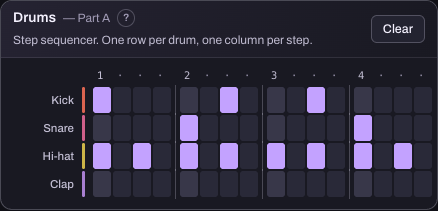
This reference capture shows a music tool the adult can use to understand a pattern. It is not a requirement for the offline activities above or a route around account-age restrictions.
The companion Prepare a pulse-and-pattern activity course demonstrates a pulse and backbeat in a separate practice space. The adult can use it as preparation, then return to the offline activity. Course completion does not assess a child’s skills and does not create a song or child account.
Adapt the plan and check access separately
The age-based activities offer starting ideas for different teaching levels. Adjust to the learner’s interests, access needs and available support. There is no fixed duration or universal age at which a learner must complete this sequence.
Under-13 accounts are unavailable. An age label on an activity does not change eligibility. Follow the family access guide and current service rules before involving a young person in an app activity; do not share an adult password as a substitute for supervised setup.
Teaching reference and limits
England’s music programmes of study connect listening, performing and composing. Those broad strands inform the sequence here. They do not establish that this page meets every curriculum requirement or that this activity has been tested with children.
For a different shared activity, try making a first song together. Physical instrument technique calls for appropriate individual guidance beyond these listening and pattern activities.
About this guide
Prepared for Hearhood by Scopra with AI assistance. The three activities and planning note are editorial suggestions for an adult-led offline session. No learner results or curriculum accreditation are claimed. Read about Hearhood.