Music activity pack for ages 14-17: make a choice and explain it
Develop a short musical brief, compare options and keep the version that serves your idea. These are adult-supported offline activities. No instrument, app, child account, recording or public sharing is required. Age bands are suggestions, not ability tests. Choose any suitable level and adapt the response to the learner.
Use around 10-15 minutes for one activity if helpful. The suggested band and duration are flexible starting points. An adult can read the prompts aloud. For older learners, agree together whether they want a partner or just help setting up.
Before you start
Use paper and a pencil. Sounds can be soft taps, spoken words or comfortable humming. Pointing, drawing or describing a choice are alternatives; they can support planning and discussion without claiming to reproduce every listening or performing task. Pause or change the activity whenever needed.
Rhythm: shape a four-bar handover
For this activity, a bar is one group of four steady counts. Mark a sparse pattern for bars one and two, a contrasting pattern for bar three, and a clear ending in bar four. Compare a busy ending with a quieter ending while keeping the pace fixed.
Ask: Which ending makes the next section easiest to anticipate? What evidence can you hear or see in the pattern?
Make it simpler: Draw and count the sequence instead of performing both layers at once.
Try another step: Keep the last bar but move the contrast earlier. Compare without changing the speed.
Keep a note: Sketch four groups of four boxes. Keep two versions of the last bar.
Melody: test a short motif
A motif is a short musical idea you can recognise when it returns. Hum a comfortable four-note idea or describe its contour. Make A a direct repeat. For B, keep the rhythm and change the ending. Decide which better suits a calm or restless brief you chose.
Ask: Which feature supports the mood you intended? Could someone reasonably prefer the other version?
Make it simpler: Work with up, down and same marks, or let a partner hum the contour. A drawing plans the music; it does not prove what it sounds like.
Try another step: Keep the ending but change one note length. Check whether rhythm changed your judgement.
Keep a note: Record the brief, sketch both contours and give one specific reason for your choice.
Songwriting: edit a hook for a purpose
Choose an invented scene, such as a station after the final train. Write two lines and choose a phrase to repeat. Keep draft A. For B, replace one general statement with a concrete image, then speak both at the same pace. The learner decides what to share, including keeping it private.
Ask: Does the repeated phrase carry your main idea? Which edit helps the listener picture the scene?
Make it simpler: Explain the scene aloud, then choose one sentence to shorten. Rhyming is optional.
Try another step: Write a contrasting verse line that adds information before the hook returns.
Keep a note: Keep the before-and-after lines, underline the edit and say what you intended it to change.
Copy this practice record
Copy these prompts onto paper. Keep two drafts if the activity compares versions. A short description is enough; no name, school, account or recording is needed.
- We chose: rhythm / melody / songwriting.
- Our starting idea: write, draw or describe it.
- Version A: keep the first pattern, shape or words.
- Version B, if we tried one: mark the change.
- What we noticed: name one difference, or say we are not sure yet.
- The learner wants to keep: one choice and, if useful, a reason.
- Next time: repeat / simplify / change one thing / try a different activity.
For a rhythm drawing, use four boxes labelled 1, 2, 3, 4. X means a sound on that count; a dash means a space. Each box represents a whole count in this simple exercise, not every possible rhythm. For a melody, arrows describe pitch movement, not loudness or exact notes.
Optional preparation for the adult
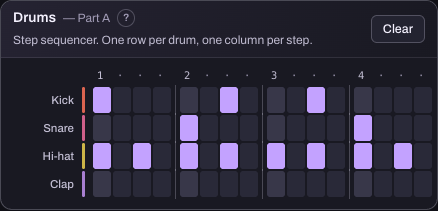
This existing reference screenshot shows a screen rhythm pattern. It is for an adult who wants a separate way to explore a pattern before the offline activity. The grid is not the paper worksheet and is not needed to complete this pack. It does not demonstrate a child using the service. The current Prepare a pulse-and-pattern activity short course is another separate adult preparation option.
Choose the next step
Pick one sketch to develop privately. An adult or eligible learner can use the linked arrangement guide as a separate next step after checking current service access. See the next-step guide or the home music activity plan.
Under-13 accounts are unavailable. An activity age label does not grant app access. Check the current family access guide before any separate screen activity; do not use a shared adult password as a substitute for supervised setup. Read the family access guide.
About this pack
Prepared for Hearhood by Scopra with AI assistance. These original editorial activities connect listening, making and discussing musical choices. England's music programmes of study are a broad reference, not evidence of curriculum accreditation or tested learner outcomes. The packs do not teach physical instrument technique. See England's music programmes of study. The four age packs offer different tasks, not a required sequence or an assessment.