A four-week music plan for ages 8-10
Use one small focus each week: rhythm, melody, words, then a short idea that joins your favourites. This is a flexible parent plan, not four deadlines or a test. Repeat a week, change the order or stop when that better fits the learner. The age band is a suggested starting level.
The child activities are offline and use paper, a pencil and optional soft sounds or comfortable humming. No instrument, app, child account, recording or public sharing is required. Older learners can decide whether they want a partner or just help setting up. Pointing, drawing and describing support planning and discussion; they do not claim to reproduce every listening or performing task.
Before the first week
Open the ages 8-10 activity pack. Choose one activity for the first session and leave the rest for later. Ask what the learner wants to try. A few minutes is enough to begin; there is no required lesson length or weekly completion score.
Week 1: move a sound, keep the pace
Use pattern A on counts one and three, then B on two and four. Keep the counting pace the same. Ask what changed before making a new pattern.
Keep: Draw both four-count patterns.
Ask together: Can you name the changed positions without calling either version wrong?
Week 2: change an ending
Use the pack's three-note melody task. Repeat the first two notes, change only the ending and choose a version to keep. A partner can hum the written shape.
Keep: Mark the changed ending with a circle.
Ask together: Did we change pitch, pace or both?
Week 3: replace a detail
Use the cardboard rocket lyric. Replace one detail and speak both versions over the same pulse. Stretch a word or leave space rather than rushing to fit.
Keep: Keep both lines and underline the replacement.
Ask together: What did the new detail help us imagine?
Week 4: build a two-part postcard
Invent a postcard from a city made of paper. In part A, use one rhythm and the original lyric. In part B, keep the count but change the lyric detail or melody ending. Choose only one musical change at first.
Keep: Label A and B and write the choice you changed.
Ask together: Which change made part B recognisable?
Decide what happens after week four
Ask which part the learner would like to return to: sounds and timing, tunes, words, or putting ideas together. Interest can change. Repeating a favourite task is a useful next step; finishing this plan does not prove readiness for a graded exam or a particular instrument.
For a possible instrument route, use choosing a music-learning path. For more flexible home sessions, return to the home music plan.
Optional preparation for the adult
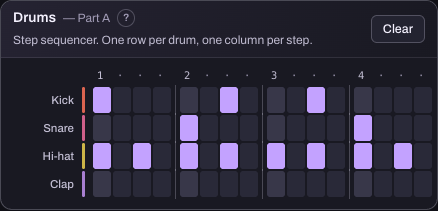
This reused app capture shows a rhythm grid for separate adult preparation. It is not the paper activity, evidence of a child session or a required step. The adult can also find Prepare a pulse-and-pattern activity under Short courses in the app. That practice course does not create a child account or assess the learner.
Under-13 accounts are unavailable. Before any separate app activity, check the current family access guide and service rules. A lesson age label does not grant access.
About this plan
Prepared for Hearhood by Scopra with AI assistance. The fourth-week prompts are original editorial examples; the earlier tasks build on the linked activity pack. Listening, performing and composing are broad strands in England's music programmes of study. This is not an accredited curriculum, a claim of tested child outcomes or physical instrument tuition.