Make a first song with your child
To make a first song together, invent one short line, speak it over a steady beat and turn it into a tune. Repeat the line, change the ending and choose the version you both want to keep. A tiny idea is enough; it does not need to become a polished recording.
This is an offline activity. You need something to write on, an invented idea and a comfortable way to mark a beat. No instrument, microphone, app login or public sharing is required.
1. Invent a line that belongs to your child
Ask for an imaginary character and something it does. For example: “The moon cat wears blue shoes.” This example was made for the activity; your child can replace any word.
If writing feels like work, let your child speak and write the words for them. A younger learner might choose only “moon cat.” A learner who wants a challenge can add a second line that answers the first.
Use imaginary details rather than a school name, address or other private information. Rhyming is optional.
2. Put the words over a steady beat
Count “one, two, three, four” at a comfortable pace. Keep the count going and speak the line naturally over it. The words do not have to fit inside one group of four. Let the phrase take the space it needs, then repeat it the same way.
Try speaking one word longer, leaving a small gap or repeating the last word. Ask, “Which version would you like to keep?” If keeping a pulse and speaking together is too much, take turns: one person marks the pulse while the other speaks.
For a separate listening exercise, see how to count beats and bars.
3. Try a tune without worrying about note names
Hum or sing the line on a comfortable note. Try making the ending a little higher, then a little lower. Your child can point up or down to choose. Speaking rhythmically is also a complete option if singing is not wanted.
There is no need to sing loudly, reach high notes or copy someone else’s voice. Stop if an activity is uncomfortable. This exercise does not assess singing technique.
4. Repeat something and change something
Say or sing your chosen line twice. On a third repeat, change just the ending: perhaps the shoes become green, or the last word lasts longer. Decide whether the new ending should stay.
This gives you a small structure you can remember: an idea, a repeat and a change. It is one possible shape for this exercise, not a rule every song must follow.
5. Keep a simple record of your idea
Write the words and a note such as “repeat twice; ending goes down.” Your child can draw an arrow or picture instead. If you want to make a private recording, ask everyone involved first and decide where it will be kept. A recording is optional.
Finish by asking which part your child made their own. That might be one word, a rhythm or the ending. You do not need a score or a public performance to recognise the choice.
Adjust the activity to the learner
For a learner who wants less to manage, offer two words and copy a short rhythm together. For someone who wants more, add a contrasting second line or try two endings and explain the difference. Older beginners can still use the short version.
The age-based music activities offer more ways to adjust. Their age bands describe teaching ideas, not account eligibility.
Take the idea further, if your child wants to
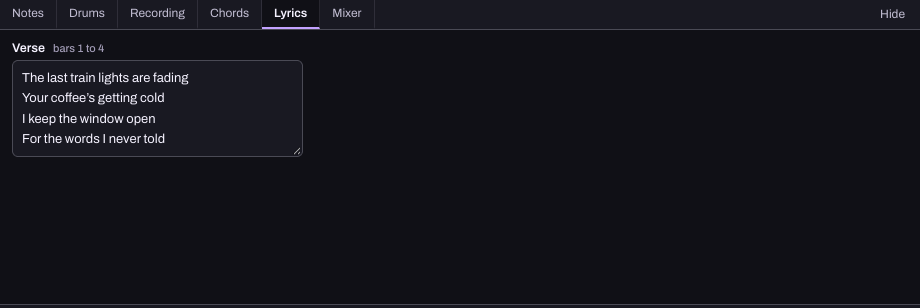
This reference capture shows a separate example of written lyrics in Hearhood. Typing lyrics does not generate a sung vocal. The paper-and-voice activity above needs neither this screen nor an account.
The lyrics guide explains verse and chorus ideas. The guide to fitting lyrics to a melody is a next step when words feel rushed or awkward.
Hearhood’s app tools are a separate option for eligible learners; this activity does not require them. Under-13 accounts are unavailable. Before using a service with a young person, check the current access rules and the family guide.
Quick answers
Is this a whole song? It is a small original song idea. You can stop there or return later to add another part.
What if the words do not rhyme? Keep them. Rhyme is one choice, and this activity works without it.
What if my child does not want to sing? Speak the words rhythmically, choose sounds or draw the shape of the phrase instead. Do not require a performance.
About this activity
Prepared for Hearhood by Scopra with AI assistance. The invented example is an activity prompt, not a report of a lesson tested with children. This guide does not assess instrument or vocal technique. See about Hearhood.