Count beats and bars by listening
To count beats in a steady 4/4 example, follow the pulse and count “one, two, three, four,” then return to one. Each group of four beats is a bar. Counting bars helps you describe where a musical change happens, but not all music uses four beats per bar.
Beat, bar and phrase
- Beat: the regular pulse you might tap your foot to.
- Bar: a group of beats defined by the music's meter.
- Phrase: a larger musical idea or grouping that can span several bars.
In many dance tracks, phrases form regular groups, but there is no universal rule that every change happens after eight or sixteen bars. Listen for new or missing parts, fills and changes in the melody as well as counting.
1. Begin with a steady example
Open Produce and use the first-beat exercise to make a simple four-beat pattern. A kick on steps 1, 5, 9 and 13 marks the four main beats. Leave the meter on four beats for this exercise.
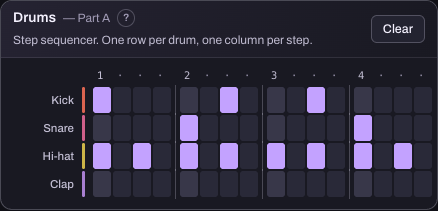
Press Play. First tap the pulse without counting. Then count 1–2–3–4. On another listen, replace the first number with the bar number: “1–2–3–4, 2–2–3–4, 3–2–3–4, 4–2–3–4.” That second count tracks where you are across four repeats.
For a closer look at pulse speed, see BPM and tempo explained.
2. Do not count every sound as a beat
The hi-hat can play between the beats. Faster notes do not necessarily mean a faster tempo. Keep your tapping steady while the smaller sounds pass between the taps.
If you are unsure where beat one falls in another track, listen for a repeated musical pattern and test your count over several bars. An opening vocal or pickup can begin before the first full bar, and some recordings have a freer pulse.
3. Use the count in DJ practice
Load a familiar, authorised music file in Hearhood's DJ workspace on a computer. Listen to one track before adding another. Predict where a change might arrive, then listen to what actually happens. The phrasing exercise develops this skill.
Counting does not automatically synchronise two tracks. Use the first transition guide to explore how the tracks enter and leave a mix. Focus on one listening goal at a time.
A useful stopping point
Try to keep a steady pulse for four bars, restart the count at each new bar and describe where a musical event happens. If you lose the count, restart from a clear point rather than speed up to catch it.