AI and music: what are artists worried about?
The debate about AI and music covers several different questions: who agreed to a system learning from existing music, who gets paid, what happens to someone's voice, and how much of the creative work a musician wants to hand over. Someone can welcome help with a difficult control and still object to their recordings being used without permission.
If you are learning to make music, you do not have to settle the whole debate before writing your next verse. It helps to understand what a particular tool does, what choices it leaves you and which questions its provider can actually answer.
What does “AI in music” mean?
It is a broad description, rather than one way of working. Asking for an explanation of a chord, generating a finished track and making a synthetic voice resemble a person involve different decisions. They should be discussed separately.
- Learning help: an explanation of a term or a suggestion for an exercise. You still need to check whether the advice fits your music.
- Creative suggestions: proposed lyrics, notes or arrangements that you might edit, reject or build on.
- Generated recordings: a system produces musical audio. How much the person contributes varies with the tool and the process.
- Voice imitation: a system reproduces aspects of a person's vocal identity. Permission and the effect on that person deserve particular attention.
These are working distinctions for this guide, not legal categories or a ranking of which musicians count. A feature's name alone does not establish how its model was trained or what rights its user receives.
Why are musicians concerned about AI?
Much of the concern is about control over work and livelihoods. It is reasonable to ask whether a musician agreed to a particular use of their recordings, whether they share in its value and whether customers could replace a paid commission with a generated result.
In SAMRO's April 2026 survey of 502 members, 65% rated AI as a high or extreme threat to music creators' livelihoods. In the same survey, 51.2% thought it could also create opportunities. Those answers can coexist: recognising a useful tool does not mean accepting every use of it. The respondents were SAMRO members, 97.2% based in South Africa; these findings do not represent every musician or the Dutch industry. Read SAMRO's survey and respondent profile.
The Musicians' Union's November 2025 summary of UK Music research also reports strong demand for consent before training and payment when music is used. That is evidence of the concerns raised by respondents, rather than a statement that every provider has the same practices. Read the Musicians' Union summary.
Consent and payment are separate questions
“Can I use the result?” and “Did the people behind the training material agree to its use?” ask different things. A subscription price or a commercial-use claim does not, by itself, answer both.
Before relying on a service, look for specific information about its training material, permissions and arrangements with rights holders. If the answer is missing, describe it as unknown. Avoid turning an unclear answer into either a guarantee or an accusation.
More output does not automatically mean more opportunity
Making something quickly can help with a private experiment. Earning from music also involves finding listeners, building relationships and offering something people value. A tool that speeds up one task cannot promise those outcomes.
For someone paying for recording sessions or depending on commissions, the stakes may be very different from those of a person trying their first four bars. Useful conversations leave room for both experiences.
What do listeners care about?
Listeners' reactions are mixed too. In a Deezer-commissioned Ipsos survey of 9,000 adults across eight countries, including the Netherlands, 64% thought AI could reduce creativity in music production. Among the survey's 6,791 music-streaming users, 66% said they would listen to fully AI-generated music at least once out of curiosity. Curiosity is not the same as a preference, a paid subscription or lasting support for an artist. Read the results and methodology.
The online survey ran on 6–10 October 2025 among adults aged 18–65, with quotas for nationally proportional representation. Deezer commissioned the research and has its own commercial position in this debate. These are dated survey results, not a forecast of what your audience will do.
How can you keep control of your own music?
Start with a decision you want to make. For example, “I want the chorus to feel more open, but I want to keep this melody.” That gives you a way to judge any suggestion, whether it comes from software, a friend or a teacher.
Save your existing version. Change one thing, listen, and ask what improved. If you cannot explain why you prefer the new version, you can still like it, but it may be worth comparing again before replacing your original.
When asking a person for feedback, give them something focused to respond to: “Does the chorus arrive clearly at 0:35?” is easier to answer than “Is my song good?” A second pair of ears can respond to what they actually hear, and you can ask about the moment where your intentions did not come across.
You can also choose to work without AI. Writing your own lyrics, placing notes, playing an instrument and practising transitions remain valid starting points. You do not need to justify that preference.
Where does Hearhood fit?
Hearhood's creative tools can be used without its optional AI assistant. The assistant can explain controls and support some changes using project information. It does not hear your audio, so its response cannot replace someone listening to your performance or mix. Its separate access requirements and limits are explained in the assistant guide.
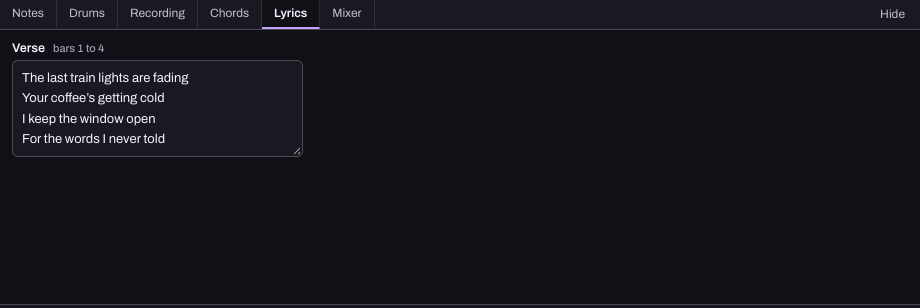
If you want to use it for a small task, our existing guide explains how to ask a specific question and keep your own musical direction. If you would rather start with your own words, follow the lyrics-first guide.
Fairer support for artists is part of the ambition behind Hearhood. An artist payment system and a licensed listening catalogue need funding, permissions and clear agreements. They are not earnings we can promise you from trying the creative-tools beta. About Hearhood separates the current product from the longer-term plans.
Questions to ask before choosing an AI music tool
- What does it actually do? Explain a control, suggest notes, generate audio or imitate a voice?
- What does it receive? Check whether it needs text, project information, recordings or other files.
- What can I keep and edit? Find out whether you can save an editable version as well as a listening copy.
- What permissions are explained? Look for the provider's current terms and specific answers about the material it uses.
- What happens if I stop paying? Check access to existing projects, downloads and any limits on future use.
- Can I keep working without it? Decide whether you want an occasional suggestion or an essential part of your workflow.
If you cannot find an answer that matters to you, ask before uploading something valuable. There is no obligation to use every feature a product offers.
Common questions about AI and music
Does using an AI assistant mean I did not write my song?
That depends on what it contributed and what you created yourself. An explanation of a control and generated lyrics are different contributions. Describe the actual process when discussing authorship with collaborators. A single label cannot settle ownership or originality.
Can AI feedback tell me whether my song sounds good?
First check whether the system can receive and analyse audio at all. Hearhood's assistant cannot hear your audio. It can explain a musical idea using project information, but it cannot judge the tone of your voice or claim it listened to your mix. Listen yourself and ask a person for feedback when you need another listener's response.
Can I make music in Hearhood without using AI?
Yes. You can use the creative tools without the optional assistant. Pick a small task from the beginner guides, such as a short lyric, a beat or a DJ listening exercise.
Will AI make it easier to earn from music?
It may reduce the effort involved in a particular task. That does not establish demand for the result, permission to release it or a dependable income. Treat earnings claims as something to investigate, not a reason to assume a subscription will pay for itself.